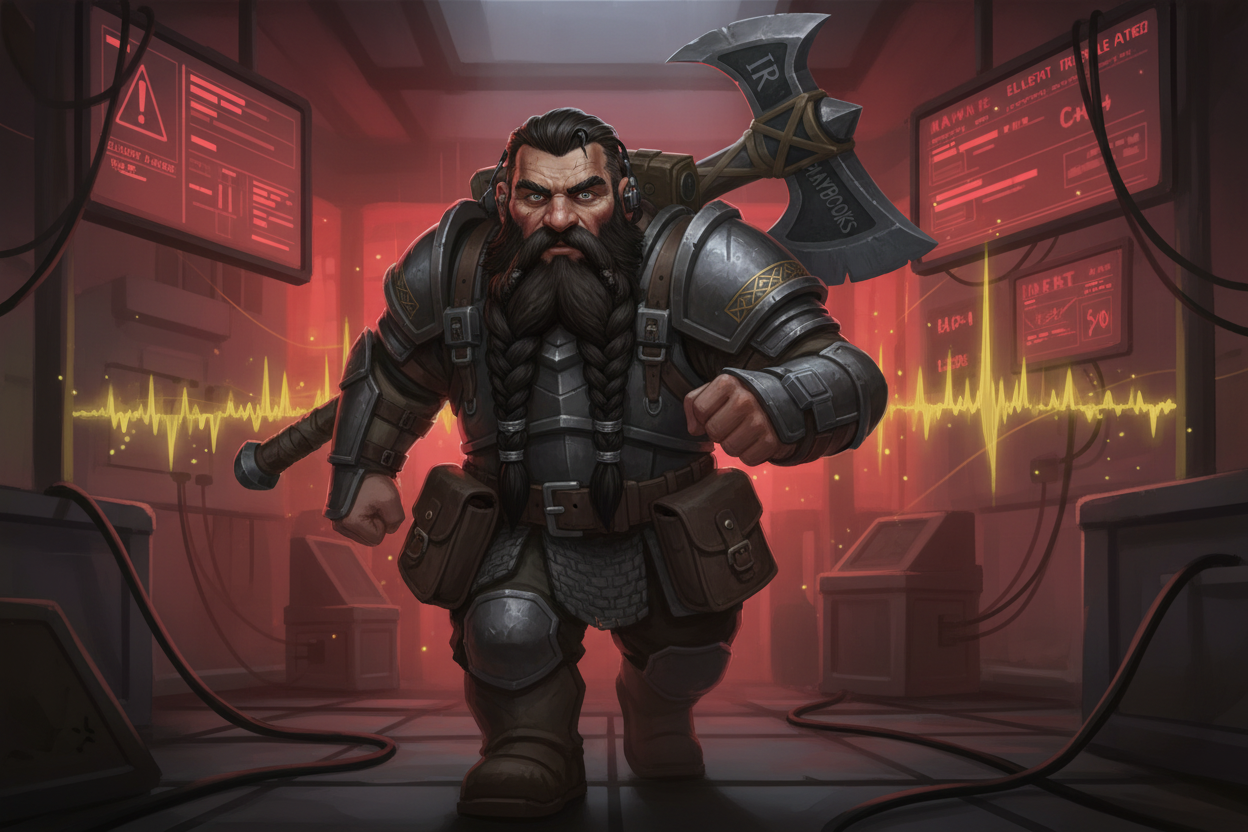

💪 Barbarian → Incident Responder
“The alert fires at 2 AM. You don’t panic. You move.”
Your Role in the Party
When crisis hits, you charge in. While others prepare defenses and analyze threats, you’re the one who takes action when things go wrong. Incident Responders contain breaches, eradicate threats, and restore operations—often under extreme time pressure while the business watches.
Incident Responders operate at the intersection of forensics, threat hunting, and crisis management. You need to understand how attackers operate, how to collect and preserve evidence, and how to make rapid decisions with incomplete information. The work is high-pressure but deeply rewarding—when you contain a breach, you directly protect the organization.
This role rewards action under pressure. The best incident responders stay calm when others panic, make decisions quickly, and execute containment while simultaneously gathering evidence. If you thrive in chaos and find clarity in crisis, you’re built for this.
📊 Your Stat Spread
| Stat | Score | What It Means for You |
|---|---|---|
| STR | ⭐⭐⭐⭐ | Hands-on containment. You implement actions—isolate hosts, block IPs, revoke credentials. |
| CON | ⭐⭐⭐⭐⭐ | 18-hour incident marathons. You persist through the entire response without burning out. |
| DEX | ⭐⭐⭐⭐ | Adapt rapidly as incidents unfold. New information changes your approach instantly. |
| WIS | ⭐⭐⭐ | Intuitive triage decisions. “This needs attention now” instincts that prove correct. |
| INT | ⭐⭐ | Learn what you need during crisis. Just-in-time knowledge acquisition. |
| CHA | ⭐⭐ | Action over talking. Brief stakeholders when needed, then get back to work. |
🎭 Neurodivergent Advantages
Your traits are class features, not bugs:
-
Hyperfocus During Crisis (CON): When an incident kicks off, your brain locks in. Those 18-hour response sessions where you don’t notice time passing? That’s hyperfocus working exactly as designed. Crisis triggers the focus state that’s elusive in normal work.
-
Calm Under Pressure: Many neurodivergent brains function better in crisis than in normalcy. The external urgency provides the structure and stakes that help you operate at peak performance.
-
Rapid Adaptation (DEX): ADHD’s ability to context-switch becomes an advantage when incidents evolve rapidly. New information, new attack vector, new containment requirement—you pivot without getting stuck.
-
Hands-On Learning (STR): You learn by doing, not by reading procedures. IR work is fundamentally hands-on—running queries, isolating hosts, examining artifacts. Theory matters less than execution.
-
Pattern Recognition During Chaos: Both ADHD and autistic brains can spot patterns that others miss, especially under pressure. The log entry that doesn’t fit, the behavior that signals lateral movement.
-
Direct Communication: During incidents, clarity matters more than diplomacy. Your tendency to say exactly what you mean is an asset when briefing leadership on breach status.
🗺️ Career Path
SOC Analyst → Incident Responder → Senior IR → IR Lead → IR Manager/CISO
       ↓             ↓                 ↓             ↓
  (Foundation)   (Crisis mode)   (Lead responses)  (Executive
                                                    leadership)
Alternative Entry Points:
- System Administrator → Incident Responder (infrastructure knowledge)
- Forensics Analyst → Incident Responder (evidence handling skills)
- Penetration Tester → Incident Responder (attacker mindset)
Common Barbarian Multiclasses:
- Barbarian/Wizard: Incident Responder → Forensics Lead (deep-dive post-incident analysis)
- Barbarian/Ranger: Incident Responder → Threat Hunter (proactive incident prevention)
- Barbarian/Warlock: Incident Responder → Consultant (respond across multiple organizations)
📜 Certification Pathway
Level 1-5: Foundation (0-2 years)
| Certification | Org | Type | Cost | Why It Fits |
|---|---|---|---|---|
| CompTIA Security+ | CompTIA | Multiple Choice | ~$425 | Foundation. Understand security concepts before responding to incidents. |
| CC (Certified in Cybersecurity) | ISC² | Multiple Choice | ~$199 | Entry point. No experience required. Great for career changers. |
| BTL1 (Blue Team Level 1) | Centri | Practical (24-hr) | Hands-on blue team. 24-hour practical simulates real incident response. |
Neurodivergent Note: BTL1’s practical format rewards hands-on learners. No memorization—just demonstrate you can respond to incidents. ISC² CC is low-pressure and cheap for building confidence—it was free until ISC² closed that program in May 2026.
Level 6-10: Specialization (2-5 years)
| Certification | Org | Type | Cost | Why It Fits |
|---|---|---|---|---|
| GCIH (GIAC Certified Incident Handler) | SANS/GIAC | Practical | ~$999 (exam) + ~$8,780 (SEC504) | THE incident response cert. SEC504 is legendary. DoD 8570/8140 approved. Passing score: 69%. |
| CompTIA CySA+ | CompTIA | Multiple Choice | ~$404 | Detection and response fundamentals. Recently updated for cloud and web apps. |
| CCD (Certified CyberDefender) | CyberDefenders | Practical | ~$400 | Hands-on blue team. More affordable than SANS. |
| ECIH (EC-Council Certified Incident Handler) | EC-Council | Multiple Choice | ~$999 (on-demand course + exam) | Budget alternative to GCIH. EC-Council’s IR certification. |
Neurodivergent Note: GCIH is the gold standard—open book, practical CyberLive components, and SEC504 teaches from the attacker’s perspective. According to 2025 data, GCIH holders average $132,000/year.
Level 11-15: Advanced (5-8 years)
| Certification | Org | Type | Cost | Why It Fits |
|---|---|---|---|---|
| GCFA (GIAC Certified Forensic Analyst) | SANS/GIAC | Practical | ~$999 (exam) + ~$8,780 (FOR508) | Advanced forensics during incidents. FOR508 combines IR with threat hunting. |
| GCIA (GIAC Certified Intrusion Analyst) | SANS/GIAC | Practical | ~$999 (exam) + ~$8,780 (SEC503) | Network-based incident analysis. Deep packet-level investigation. |
| GNFA (GIAC Network Forensic Analyst) | SANS/GIAC | Practical | ~$999 (exam) + ~$8,780 (FOR572) | Network forensics for incident response. |
Neurodivergent Note: GCFA is the natural progression from GCIH—deeper forensics, threat hunting integration. FOR508 has 35 hands-on labs and is often called the “gold standard” in DFIR. Many professionals pair GCIH + GCFA for comprehensive IR validation.
Level 16-20: Mastery (8+ years)
| Certification | Org | Type | Cost | Why It Fits |
|---|---|---|---|---|
| GSOM (GIAC Security Operations Manager) | SANS/GIAC | Practical | ~$999 (exam) + ~$8,260 (LDR551) | Lead incident response teams. Management skills for IR leadership. |
| CISSP | ISC² | Multiple Choice | ~$749 | Executive credibility. Opens doors to CISO track. |
| CISM | ISACA | Multiple Choice | ~$575 (member) / $760 (non-member) | Security management. Bridge between IR leadership and executive roles. |
🛠️ Your Toolkit
Primary Weapons
| Tool | Type | What It Does | Link |
|---|---|---|---|
| Velociraptor | Endpoint IR | Enterprise-scale endpoint visibility. Hunt and respond across your fleet. | velociraptor.app |
| KAPE | Triage | Rapid artifact collection. Targeted forensic collection during incidents. | GitHub |
| CrowdStrike Falcon | EDR | Industry-leading endpoint detection and response. Real-time containment. | crowdstrike.com |
| Microsoft Defender for Endpoint | EDR | Microsoft’s EDR solution. Strong integration with Azure environments. | Microsoft |
Incident Management
| Tool | Purpose | Link |
|---|---|---|
| TheHive | Incident tracking and case management | thehive-project.org |
| IRIS | Incident response investigation system | GitHub |
| Cortex XSOAR | Security orchestration and automated response | paloaltonetworks.com |
| Shuffle | Open-source SOAR platform | shuffler.io |
Evidence Collection & Analysis
| Tool | Purpose | Link |
|---|---|---|
| FTK Imager | Forensic imaging during incidents | exterro.com |
| Volatility 3 | Memory analysis for malware and artifacts | GitHub |
| Chainsaw | Rapid Windows event log hunting | GitHub |
| Eric Zimmerman Tools | Windows artifact parsing | ericzimmerman.github.io |
| THOR Lite | IOC and anomaly scanner | nextron-systems.com |
Network Response
| Tool | Purpose | Link |
|---|---|---|
| Wireshark | Network traffic analysis | wireshark.org |
| Zeek | Network security monitoring | zeek.org |
| tcpdump | Command-line packet capture | Built-in on most systems |
| NetworkMiner | Network forensic analysis | netresec.com |
Fun Tools from Awesome Lists
Source: awesome-incident-response
| Tool | What It Does |
|---|---|
| GRR Rapid Response | Google’s remote live forensics |
| OSQuery | SQL-powered endpoint visibility |
| DFIR-ORC | French ANSSI forensic artifact collection |
| CyLR | Cross-platform forensic collection |
| UAC (Unix-like Artifacts Collector) | Linux/Unix artifact collection |
| FastIR Collector | Windows artifact collection |
📚 Learning Resources
Free Resources
YouTube Channels:
- 13Cubed - DFIR tutorials and analysis
- SANS Digital Forensics & Incident Response - Official SANS DFIR content
- Black Hills Information Security - Active defense and IR
- John Hammond - IR and forensics walkthroughs
Practice Platforms:
- TryHackMe - “Incident Response” and “SOC Level 2” paths
- CyberDefenders - Blue team CTFs with IR scenarios
- LetsDefend - SOC simulation including incident response
- Blue Team Labs Online - Hands-on DFIR labs
Essential Reading:
- NIST SP 800-61 Rev 2 - Computer Security Incident Handling Guide (THE standard)
- SANS DFIR Reading Room - Free research papers
- CISA Incident Response Playbooks - Government playbooks
Books for Barbarians
| Book | Author | Why Read It |
|---|---|---|
| Incident Response & Computer Forensics | Luttgens, Pepe, Mandia | Comprehensive IR methodology. From Mandiant practitioners. |
| Blue Team Handbook: Incident Response | Don Murdoch | Practical IR reference. Quick lookup during incidents. |
| The Practice of Network Security Monitoring | Richard Bejtlich | Network-based detection and response. Classic text. |
| Applied Incident Response | Steve Anson | Hands-on IR techniques. Modern and practical. |
| Intelligence-Driven Incident Response | Scott Roberts & Rebekah Brown | CTI-informed IR. Strategic approach. |
| Crafting the InfoSec Playbook | Jeff Bollinger et al. | Building detection and response capabilities. |
Podcasts
| Podcast | Why Listen |
|---|---|
| Darknet Diaries | Real incident stories. What you’re defending against. |
| SANS Internet Storm Center | Daily threat updates relevant to IR. |
| Risky Business | Weekly security news with IR context. |
| Malicious Life | Historical incidents and breaches. |
🎓 SANS Courses for Barbarians
| Course | Cert | Focus | Best For |
|---|---|---|---|
| SEC504: Hacker Tools, Techniques, and Incident Handling | GCIH | Core incident handling | Essential for all Barbarians |
| FOR508: Advanced IR, Threat Hunting, and Digital Forensics | GCFA | Advanced IR and forensics | Senior responders |
| SEC503: Network Monitoring and Threat Detection | GCIA | Network-based IR | Network-focused IR |
| FOR572: Advanced Network Forensics | GNFA | Network forensics | Network incident analysis |
| FOR500: Windows Forensic Analysis | GCFE | Windows forensics | Windows-focused IR |
🏆 Building Your Magic Items
Early Career Achievements:
- Complete TryHackMe “Incident Response” path
- Build an IR home lab with TheHive and Velociraptor
- Participate in your first incident (even as support)
- Create an incident response runbook
- Practice artifact collection with KAPE
Mid-Career Achievements:
- Lead an incident response engagement
- Earn GCIH certification
- Contain a significant breach
- Build IR playbooks for your organization
- Present incident post-mortem to leadership
Senior Achievements:
- Lead IR for major/breach incidents
- Earn GCFA certification
- Speak at a security conference on IR topics
- Build or lead an IR team
- Mentor junior responders
🧭 Multiclassing Guide
Adding Wizard Levels (Forensics)
Deep-dive analysis post-incident:
- SANS FOR500 for Windows forensics fundamentals
- Master evidence preservation and analysis
- Produce detailed forensic reports
“After the dust settles, I reconstruct exactly what happened—every artifact, every timestamp.”
Adding Ranger Levels (Threat Hunting)
Prevent incidents before they happen:
- SANS FOR508 combines IR with hunting
- Use incident learnings to build hunt hypotheses
- Proactive detection before alerts fire
“I don’t just respond to incidents—I hunt for threats before they become incidents.”
Adding Warlock Levels (Consulting)
Respond across multiple organizations:
- Build IR consulting practice
- Develop portable methodology
- GCIH + GCFA for comprehensive validation
“I respond to incidents at organizations around the world. Every breach teaches me something new.”
💡 Neurodivergent Learning Strategies
For ADHD:
- Crisis provides the external stakes that trigger hyperfocus
- IR’s variety helps—new incidents, new attack vectors, new challenges
- Use the adrenaline of response as motivation
- Build playbooks to ensure systematic coverage when focus is split
For Autism:
- NIST 800-61 provides structured methodology
- Build comprehensive personal runbooks and procedures
- Document lessons learned systematically
- Pattern recognition helps identify attack techniques
For Both:
- Hyperfocus during incidents is your competitive advantage
- Your ability to work 18-hour marathons without burnout is genuine
- Direct communication is valued during crisis
- Independent, decisive action is exactly what IR requires
🎯 Not Sure If You’re a Barbarian?
Take the Character Creation Quiz to discover your cybersecurity class and get personalized recommendations!
📖 Continue Your Journey
- View All Classes
- Blue Team: Wizard - If deep forensics calls to you
- Blue Team: Ranger - If proactive hunting is your focus
- Blue Team: Fighter - Build SOC experience first
“When the breach happens, everyone panics. Except you. You move.”
Work an Incident
Before you grind certs, try the job. These interactive incidents put you in the Incident Responder's seat — read the evidence, make the calls, live with the consequences.