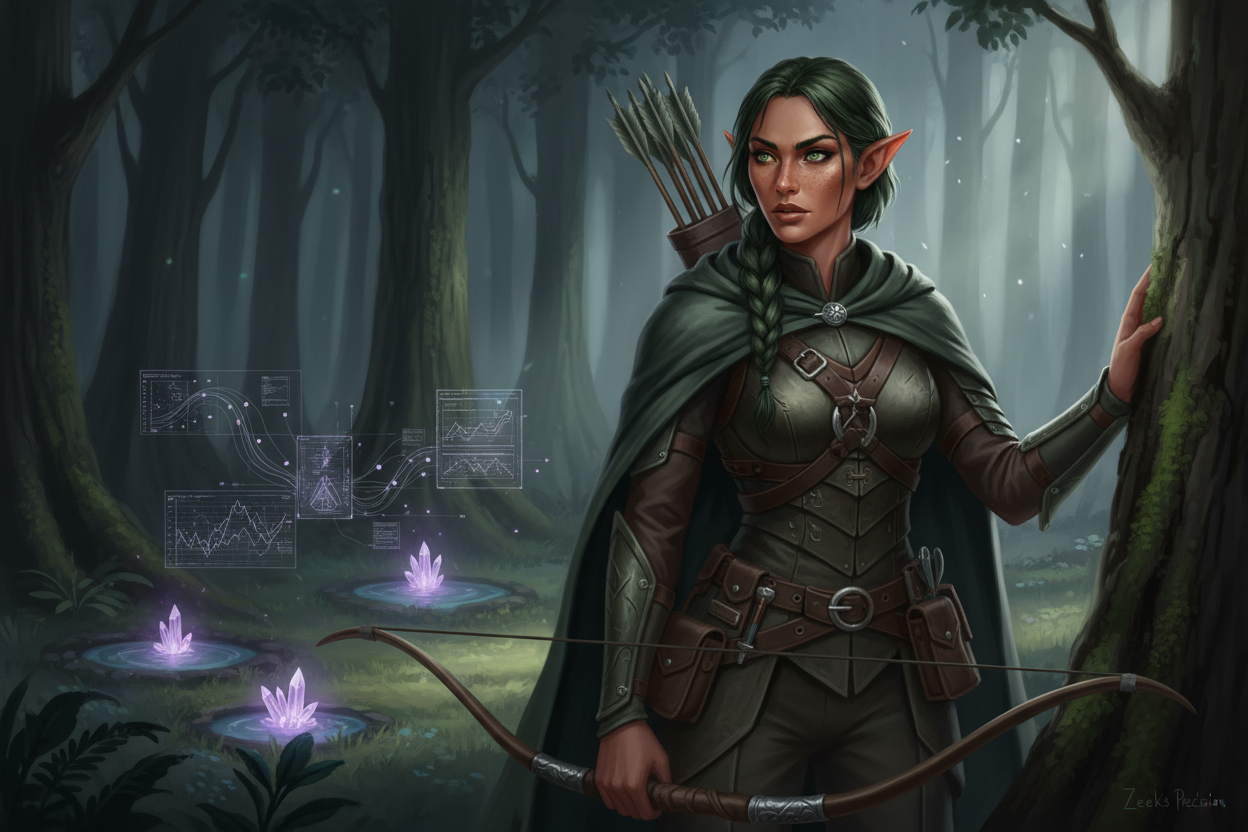

🏹 Ranger → Threat Hunter
“The alerts tell you what they found. Hunting tells you what they missed.”
Your Role in the Party
While SOC Analysts wait for alerts to fire, you venture into the wilderness of logs and telemetry to find threats that automated detection missed. You don’t wait for the enemy to announce themselves—you track them through the digital terrain before they reach their objective.
Threat Hunters are the proactive arm of defense. You develop hypotheses about adversary behavior, test them against your environment’s data, and either find evil or improve detection coverage. Either outcome is a win.
This role rewards curiosity. The best hunters are the ones who can’t stop asking “what if?” and who find genuine satisfaction in the chase—even when the trail goes cold.
📊 Your Stat Spread
| Stat | Score | What It Means for You |
|---|---|---|
| WIS | ⭐⭐⭐⭐⭐ | Pattern recognition is everything. You see the anomaly in a million events that others scroll past. |
| INT | ⭐⭐⭐⭐⭐ | Deep knowledge of adversary tactics, frameworks, and how attacks actually work. |
| CON | ⭐⭐⭐⭐ | Hunts take time. You persist through hours of dead ends before finding the trail. |
| DEX | ⭐⭐⭐ | Pivot quickly between data sources and adjust hypotheses when evidence leads elsewhere. |
| STR | ⭐⭐⭐ | When you find something, you can execute response actions and contain threats. |
| CHA | ⭐⭐ | Document findings and communicate discoveries, though your work speaks for itself. |
🎭 Neurodivergent Advantages
Your traits are class features, not bugs:
-
Pattern Recognition (WIS): Autistic attention to detail notices the subtle behavioral anomaly that rules-based detection misses. Your brain naturally processes patterns in ways neurotypical analysts can’t replicate.
-
Hyperfocus (INT): When you catch a scent, you can follow it for hours. ADHD hyperfocus is a superpower when the hunt gets interesting. You won’t stop until you’ve traced the full kill chain.
-
Special Interest in Adversary Tradecraft: If you’ve ever hyperfocused on MITRE ATT&CK, malware analysis, or how attacks work—that knowledge directly translates to hunting hypotheses.
-
Comfortable with Ambiguity: Hunting is inherently uncertain. You might find nothing, and that’s okay. Autistic comfort with systematic processes helps manage this uncertainty.
-
Independent Work Style: Much of hunting is solo work—developing hypotheses, querying data, following trails. Less context-switching and fewer interruptions than reactive SOC work.
🗺️ Career Path
SOC Analyst → Threat Hunter → Senior Hunter → Hunt Team Lead → Threat Intel Manager
      ↓              ↓              ↓
 (Foundation)  (Specialization) (Leadership or
                                 pivot to Detection
                                 Engineering)
Common Ranger Multiclasses:
- Ranger/Druid: Threat Hunter → Threat Intelligence (combine hunting with intel production)
- Ranger/Rogue: Threat Hunter → Purple Team (understand offense to hunt better)
- Ranger/Artificer: Threat Hunter → Detection Engineer (build the rules, not just use them)
📜 Certification Pathway
Level 1-5: Foundation (0-2 years)
| Certification | Org | Type | Cost | Why It Fits |
|---|---|---|---|---|
| CompTIA Security+ | CompTIA | Multiple Choice | ~$425 | Foundation. You need to understand security basics before you hunt. |
| CompTIA CySA+ | CompTIA | Multiple Choice | ~$404 | Behavioral analytics and threat detection—directly relevant to hunting. |
| BTL1 (Blue Team Level 1) | Centri | Practical (24-hr) | Hands-on incident response. Hunting builds on IR fundamentals. |
Neurodivergent Note: Build your SOC foundation first. Hunting requires experience with what “normal” looks like before you can spot “abnormal.” CySA+ covers behavioral analytics that inform hunting hypotheses.
Level 6-10: Specialization (2-5 years)
| Certification | Org | Type | Cost | Why It Fits |
|---|---|---|---|---|
| eCTHP (Certified Threat Hunting Professional) | INE Security | Practical | ~$749/yr (subscription) + ~$400 (exam) | Purpose-built threat hunting cert. Hypothesis-driven methodology, hands-on exam. |
| GCFA (Forensic Analyst) | SANS/GIAC | Practical | ~$999 (exam) + ~$8,780 (FOR508) | Advanced IR and threat hunting. FOR508 is legendary for hunt methodology. |
| GCTI (Cyber Threat Intelligence) | SANS/GIAC | Practical | ~$999 (exam) + ~$8,780 (FOR578) | Threat intel lifecycle. Intel informs hunt hypotheses. |
Neurodivergent Note: eCTHP is more accessible price-wise and specifically focused on hunting. FOR508 is the gold standard but expensive—consider if employer-funded. GCTI helps you generate better hypotheses from threat intel.
Level 11-15: Advanced (5-8 years)
| Certification | Org | Type | Cost | Why It Fits |
|---|---|---|---|---|
| GCDA (Detection Analyst) | SANS/GIAC | Practical | ~$999 (exam) + ~$8,500 (SEC555) | SIEM analytics and detection. Build the rules, not just query them. |
| CTIA (Certified Threat Intelligence Analyst) | EC-Council | Multiple Choice | ~$1,000-1,700 | Threat intel methodology. Cheaper alternative to GCTI. |
| OSDA (Blue Team) | OffSec | Practical | ~$1,649 | Offensive Security’s blue team validation. Rigorous practical exam. |
Neurodivergent Note: SEC555 (GCDA) is perfect if you want to move toward detection engineering. The course teaches you to make SIEMs actually useful, not just query them.
Level 16-20: Mastery (8+ years)
| Certification | Org | Type | Cost | Why It Fits |
|---|---|---|---|---|
| GREM (Reverse Engineering Malware) | SANS/GIAC | Practical | ~$999 (exam) + ~$8,780 (FOR610) | Deep malware analysis. Understand what you’re hunting at the code level. |
| GDSA (Defensible Security Architecture) | SANS/GIAC | Practical | ~$999 (exam) + ~$8,780 (SEC530) | Design detection architecture. Senior-level visibility strategy. |
🛠️ Your Toolkit
Primary Weapons
| Tool | Type | What It Does | Link |
|---|---|---|---|
| Elastic Security | SIEM/Hunting | Hunt queries mapped to MITRE ATT&CK. Strong KQL query language. | elastic.co |
| Splunk Enterprise Security | SIEM/Hunting | Industry standard. SPL is powerful for complex hunts. ThreatHunting app available. | splunk.com |
| Velociraptor | Endpoint Hunting | Hunt across your fleet. VQL queries for endpoint artifacts. | docs.velociraptor.app |
Hunting Platforms (Free/Low-Cost)
| Tool | Purpose | Link |
|---|---|---|
| HELK | Hunting ELK stack with Jupyter notebooks and Spark. Built for hunters. | GitHub |
| Security Onion | Full hunting stack: ELK, Zeek, Suricata, Wazuh. Free and powerful. | securityonionsolutions.com |
| osquery | SQL-powered endpoint visibility. Query your fleet like a database. | osquery.io |
| Sigma | Generic detection rule format. Write once, translate to any SIEM. | GitHub |
| Chainsaw | Rapid Windows forensic artifact hunting. Fast triage tool. | GitHub |
Detection & Simulation
| Tool | Purpose | Link |
|---|---|---|
| Atomic Red Team | Execute ATT&CK techniques to test your detections. | GitHub |
| MITRE CALDERA | Automated adversary emulation. Run attacks to hunt for. | GitHub |
| DetectionLab | Pre-built lab environment for detection testing. | GitHub |
Fun Tools from Awesome Lists
Source: awesome-threat-detection
| Tool | What It Does |
|---|---|
| EQLLib | Event Query Language analytics mapped to ATT&CK |
| Zircolite | Standalone SIGMA-based hunting for EVTX and JSON logs |
| MITRE CAR | Cyber Analytics Repository—detection pseudocode for ATT&CK |
| ThreatHunting App | Splunk app mapped to ATT&CK to guide hunts |
| Sentinel Attack | Azure Sentinel queries leveraging ATT&CK |
📚 Learning Resources
Free Resources
YouTube Channels:
- SANS Digital Forensics & Incident Response - Hunt methodology deep dives
- Black Hills Information Security - Active defense and hunting techniques
- 13Cubed - Windows forensics that feeds hunt hypotheses
Practice Platforms:
- TryHackMe - “Threat Hunting” and “Threat Intelligence” rooms
- CyberDefenders - Blue team CTFs including hunt challenges
- LetsDefend - SOC simulation with hunting scenarios
- Blue Team Labs Online - Hands-on hunting labs
Essential Reading:
- MITRE ATT&CK - Your hunting hypothesis framework
- ThreatHunter Playbook - Community hunting techniques
- Predefender Hunt Book - Free online hunting guide
- Splunk PEAK Framework - Hypothesis-driven methodology
Books for Rangers
| Book | Author | Why Read It |
|---|---|---|
| Practical Threat Intelligence and Data-Driven Threat Hunting | Valentina Costa-Gazcón | THE hunting book. ATT&CK framework, hypothesis development, hands-on exercises. |
| Cyber Threat Hunting | Nadhem AlFardan | Comprehensive methodology from hypothesis to execution. Manning publication. |
| Crafting the InfoSec Playbook | Jeff Bollinger et al. | Building detection and response capabilities. O’Reilly. |
| Intelligence-Driven Incident Response | Scott Roberts & Rebekah Brown | Combining threat intel with IR and hunting. |
| The Practice of Network Security Monitoring | Richard Bejtlich | Classic NSM text. Foundational for network-based hunting. |
Podcasts
| Podcast | Why Listen |
|---|---|
| Detection Engineering Weekly | Newsletter/podcast on building better detections |
| SANS Internet Storm Center | Daily security updates—fresh hunt hypotheses |
| Risky Business | Weekly news with technical depth |
| Darknet Diaries | Adversary stories that inform hunt hypotheses |
🎓 SANS Courses for Rangers
| Course | Cert | Focus | Best For |
|---|---|---|---|
| FOR508: Advanced IR & Threat Hunting | GCFA | Hunt methodology, memory forensics, APT detection | Core hunting skills |
| SEC555: SIEM with Tactical Analytics | GCDA | SIEM optimization, detection engineering | Building detections |
| FOR578: Cyber Threat Intelligence | GCTI | Intel lifecycle, attribution, reporting | Intelligence-driven hunting |
| FOR572: Advanced Network Forensics | GNFA | Network-based hunting, packet analysis | Network-focused hunters |
| SEC599: Defeating Advanced Adversaries | GDAT | Purple team, APT defense | Understanding attacker perspective |
🏆 Building Your Magic Items
Early Career Achievements:
- Complete TryHackMe “Threat Hunting” path
- Build a home lab with Security Onion or HELK
- Write your first Sigma rule
- Execute an Atomic Red Team test and hunt for artifacts
- Document a hypothesis-driven hunt (even if you find nothing)
Mid-Career Achievements:
- Conduct a hunt that finds real malicious activity
- Build a hunt playbook for your organization
- Present hunt findings to leadership
- Earn eCTHP or equivalent
- Contribute to ThreatHunter Playbook or Sigma rules
Senior Achievements:
- Lead your organization’s hunt program
- Speak at a security conference about hunting methodology
- Earn GCFA (FOR508) or equivalent
- Mentor junior hunters
- Publish hunt research or detection content
🧭 Multiclassing Guide
Adding Druid Levels (Threat Intelligence)
Combine hunting with intel production. Generate your own hypotheses from raw intel:
- SANS FOR578 for CTI methodology
- Study the Diamond Model and Kill Chain
- Practice with MISP and OpenCTI
“I don’t just hunt threats—I understand the adversaries well enough to predict their next move.”
Adding Rogue Levels (Offensive Skills)
Understand attacks to hunt them better:
- TryHackMe “Jr Penetration Tester” path
- Atomic Red Team execution and detection
- Study attacker tradecraft to build better hypotheses
“I know how to attack, so I know what artifacts to hunt for.”
Adding Artificer Levels (Detection Engineering)
Build the detection rules instead of just querying:
- Master Sigma rule format
- Learn your SIEM’s query language deeply (SPL, KQL, etc.)
- SANS SEC555 for detection engineering
“I don’t just find evil—I make sure we detect it automatically next time.”
💡 Neurodivergent Learning Strategies
For ADHD:
- Hunting’s variety helps—new hypotheses, new data sources, new challenges
- Use the “interesting trail” as motivation; follow what captures your attention
- Time-box hunts to prevent infinite rabbit holes (or embrace them when you can)
- Gamify: track hypotheses tested, detections created, evil found
For Autism:
- Build systematic hunt frameworks and checklists
- The structure of hypothesis → data → analysis → conclusion is comforting
- Deep-dive on specific adversary groups or TTPs as special interests
- Create comprehensive documentation of your hunt methodology
For Both:
- Leverage pattern recognition as your unfair advantage
- Use hyperfocus strategically when you catch a scent
- Independent work style fits hunting’s solo nature
- Your “weird” connections between disparate data points? That’s how hunts succeed.
🎯 Not Sure If You’re a Ranger?
Take the Character Creation Quiz to discover your cybersecurity class and get personalized recommendations!
📖 Continue Your Journey
- View All Classes
- Blue Team: Fighter - Build SOC foundations first
- Blue Team: Druid - If threat intelligence calls to you
“The adversary leaves traces. Your job is to find them before they finish the mission.”
Work an Incident
Before you grind certs, try the job. These interactive incidents put you in the Threat Hunter / Detection Engineer's seat — read the evidence, make the calls, live with the consequences.
- The 2AM AlertinitiateSOC Analyst / Incident ResponderAn EDR alert fires at 2am: PowerShell spawned from Word on a finance workstation. Work the incident — every choice trades speed against intel against containment.
- Assumed Breach DrillveteranPurple TeamerRun an assumed-breach exercise to measure detect-and-respond times. The temptation is a contest red can win; the goal is honest numbers you can actually trust.