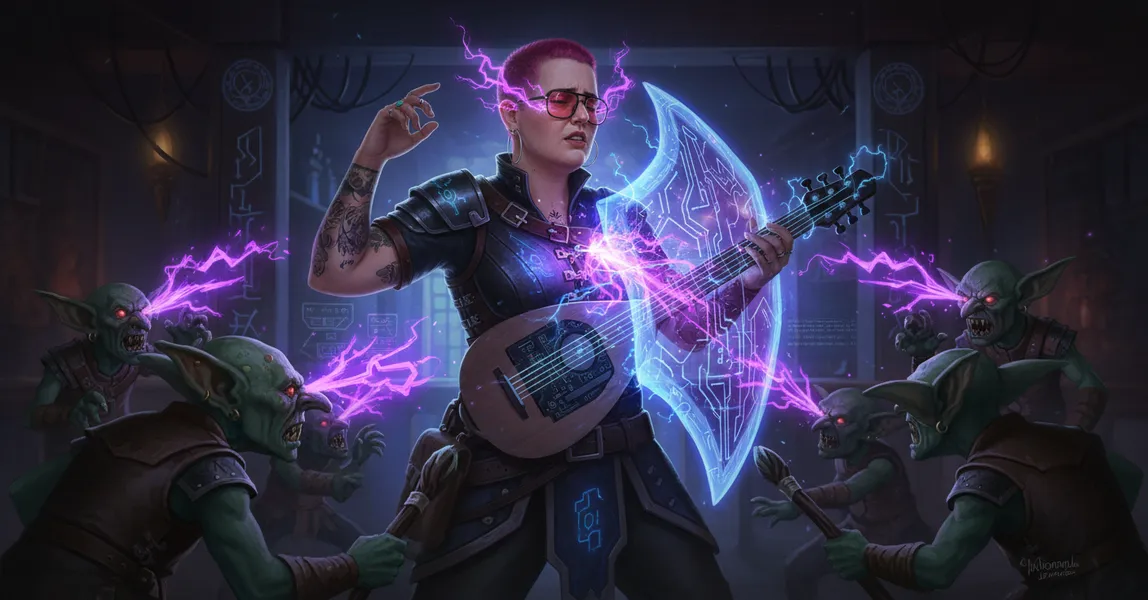
Psychic Damage Is Real: A Bard's Guide to Rejection
2026-01-15
If you’ve ever applied for a job, poured your whole self into an interview, and then gotten the “we’ve decided to move forward with other candidates” email—you know exactly what I mean by psychic damage.
It’s not physical. Nobody punched you. But your nervous system? Your nervous system didn’t get that memo. As far as your body is concerned, you just failed a critical Wisdom save and took 4d10 psychic damage straight to the ego.
I’m Liz. I’m AuDHD, I’m 40, and I’ve been job hunting. Which means I’ve been taking a lot of psychic damage lately.
But here’s the thing: I’ve actually been training for this my whole life. I just didn’t know it.
Fifteen Years of Audition Rejections (A.K.A. Pre-Career Grinding)
Before I was the Accidental IT Guy, before I was a Director of IT, before I was earning GIAC certifications and presenting at SANS conferences—I was a theatre kid. Then a theatre major. Then a theatre teacher.
And if you know anything about theatre, you know that the entire discipline is basically a rejection simulator.
Auditions are the original high-stakes Charisma check. You walk into a room, perform your heart out, and then… you wait. And most of the time? Most of the time you don’t get cast. You get a polite “thank you for coming in” and you go home and eat your feelings.
I’ve lost count of how many times I didn’t get the part. How many callbacks I nailed only to see someone else’s name on the cast list. How many times I was close but not quite right.
And somewhere along the way, something shifted.
I remember one callback in particular. I wanted the role badly. Did my best work. And when the cast list went out, I wasn’t on it. But instead of spiraling (okay, maybe a little spiraling), I found myself genuinely happy for the people who got cast. Like, actually happy. Not performatively happy. Just… at peace with it.
That was a level-up moment for me.
And then—because theatre is wild—someone had to drop out. I was next in line. Got the part anyway.
The universe has a weird sense of humor. But the lesson stuck: things have a way of working themselves out. And even when they don’t, the rejection itself isn’t a verdict on your worth. It’s just… not the right fit.
I’m Not FOR Everyone (And That’s Actually the Point)
Here’s the mindset that got me through years of auditions and is currently getting me through job hunting:
I’m not for everyone. And that’s a good thing.
I spent so much of my life trying to be palatable. Trying to be included. Trying to be useful and likeable and non-threatening and whatever version of myself I thought people wanted to see.
That’s exhausting. And it doesn’t even work—because when you’re constantly shape-shifting to match other people’s expectations, you’re not actually you. You’re just a mirror.
The countless rejections I went through in theatre conditioned me to accept something important: not everyone is going to like me. Not everyone is going to cast me. And now? Now I actively seek that out.
If everyone likes me, I’m doing something wrong. It means I’m not being ME—I’m being some watered-down, people-pleasing version that exists to make others comfortable.
I don’t want to live that way anymore.
So when I get rejected from a job, I try to remember: I wasn’t the right fit for them. And more importantly, they might not have been the right fit for me.
Let’s be real—not everyone digs the pink buzz cut, the piercings, the tattoos. And that’s actually useful information. If my appearance is a dealbreaker for a company, imagine how they’d feel about my personality. (Spoiler: I have a lot of opinions and I share them.)
The look is a filter. The rejection is data. It’s not a judgment on my worth—it’s information about cultural fit.
At least, that’s what my brain knows.
My body? My body has a different opinion.
RSD: When Your Nervous System Didn’t Read the Script
Here’s where we get into the messy part.
I have Rejection Sensitive Dysphoria. If you’re neurodivergent, you might know exactly what I’m talking about. If you’re not, let me paint you a picture:
Imagine you get a rejection email. Logically, you know it’s fine. You know you’ll apply to other places. You know this isn’t personal.
But your nervous system goes feral.
Fight. Flight. Freeze. Fawn. Some chaotic combination of all four.
I will spiral. I will ruminate. I will replay the interview in my head seventeen times, dissecting every answer, every pause, every moment where I maybe talked too fast or maybe didn’t explain myself well enough. Was it something I said? Something I wore? Did I seem too eager? Not eager enough?
This can go on for hours. Sometimes to the point of mania.
My brain KNOWS it’s just RSD. My brain has read the articles, done the therapy, understands the neurological mechanisms. My brain knows that this is a neurodivergent reaction, not a reflection of reality.
My body didn’t get the memo.
My body needs to go through the whole cycle anyway. It’s exhausting.
Sometimes I literally have to talk to myself out loud: “Hey. Listen. This is just RSD. You’re okay. It’s gonna pass. You’ve got this.”
I look unhinged. It helps.
Face-to-Face Rejection Hits Different
The hardest part of job hunting—the part that does the most psychic damage—is getting rejected after an interview.
Before the interview, it’s abstract. You’re a resume. A collection of bullet points. Easy to dismiss as “not quite what we’re looking for.”
But once it’s face-to-face? Once you’ve had a conversation, made eye contact, maybe even laughed together? It FEELS personal. Even when it isn’t.
I know, logically, that my skills aren’t the right fit for every place. That’s fine. That’s how it should be. I wouldn’t want to be a “fit” everywhere—that would mean I’m generic.
But my RSD doesn’t care about logic. My RSD sees the rejection email after an interview and whispers: “See? They met you, the real you, and they said no. You’re not just unqualified. You’re wrong.”
That’s the lie. That’s the nat 1 on the Wisdom save.
But I’ve been rolling these saves for fifteen years. I know how to take the hit and keep going.
Short Rest Mechanics: How I Actually Cope
Okay, practical stuff. Because validation is great, but sometimes you need actual strategies.
Here’s what helps me survive the psychic damage of job hunting:
Time-box the doom spiral. I give myself permission to feel terrible—but with a timer. “You have 30 minutes to wallow. Then we’re getting up and doing something else.” The wallowing is necessary. The boundary keeps it from consuming the whole day.
Distraction is a legitimate coping mechanism. I’m not above putting on a comfort show (currently rewatching New Girl) or diving into Baldur’s Gate 3 for a few hours. Sometimes your brain needs to not think about the thing. That’s not avoidance—that’s recovery.
Rearranging furniture. This one is weird, but hear me out. When I feel out of control in my life, I rearrange my physical space. It gives me something I can control. Plus, at the end of it, my living room looks different and my brain registers that as progress. Highly recommend.
Talk to someone who gets it. Between batches of applications, I meet with a career counselor (shoutout to Clara from SANS) who helps validate what I’m feeling. Having someone in your corner who understands the process—and can remind you that rejection is normal and not a character flaw—is invaluable.
Remember that rejection is redirection. This is cheesy. It’s also true. Every “no” is clearing the path for the “yes” that’s actually right for you. I got rejected from SANS Cyber Academy the first time I applied. That rejection gave me a year to build a stronger foundation. When I applied again, I got in. Things work out.
You’re Not Rolling With Disadvantage—You’re Just a Different Build
If you’re neurodivergent and job hunting, I see you. I know how much harder this process is when your brain interprets every rejection as catastrophic failure.
But here’s what I want you to remember:
Your brain isn’t broken. It’s just processing rejection differently than neurotypical brains do. That doesn’t make you less capable. It means you need different strategies.
You’re not rolling with disadvantage. You’re just playing a different character class. Bards take psychic damage hard—but we also have incredible resilience, creativity, and the ability to get back up and try again.
The audition didn’t kill my theatre career. The SANS rejection didn’t end my cybersecurity journey. And this job hunt? This job hunt is just another campaign.
I’m going to take some hits. I’m going to need some short rests. But I’m still in the fight.
And so are you.
Liz Gore is a Director of IT, SANS Cyber Academy graduate (GFACT, GSEC, GCIH), and recovering theatre teacher. She’s currently job hunting, rearranging furniture, and reminding her nervous system that rejection isn’t actually fatal. Find her at lizgore.com or crying about Baldur’s Gate 3 on the internet.