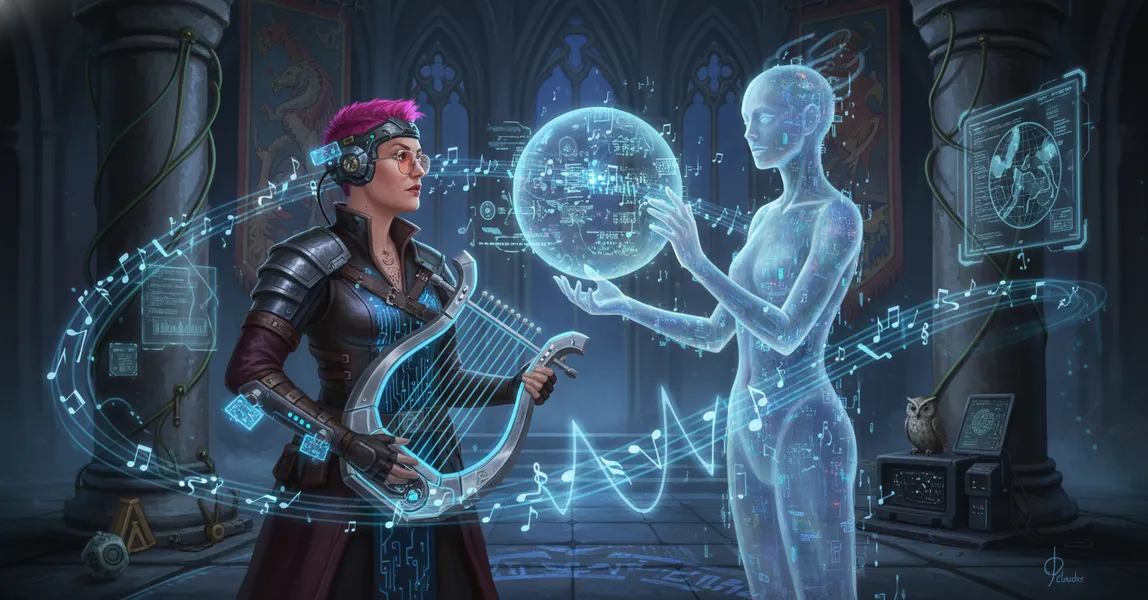
Duet With a Machine: A Bard's Guide to Getting Weird With AI
2026-03-04
I need to confess something: I’ve been using AI in ways that are absolutely not in any “Top 10 AI Productivity Hacks” listicle.
Okay, that’s not entiiiiiirely true. Some of it is genuinely practical. I wrote a script to purge thousands of phishing emails from my school district’s inboxes on a Saturday night. I built a year-long personal development curriculum. I planned an international trip on a budget. That’s the optimizing-my-workflow stuff, I guess.
But I’m ALSO using Claude to analyze my family’s birth charts, brainstorm a fantasy novel at 11 PM, trace my grandmother’s genealogy research, and settle a family argument.
I’m Liz. I’m the Accidental IT Guy turned Director of IT for a school district in New Orleans. I’m AuDHD, I’m 40, and I have the impulse control of a caffeinated squirrel when it comes to new ideas. Which means when I got access to AI tools, I didn’t just use them for work. I used them for everything.
Most AI content out there is either hyper-technical (“build a RAG pipeline in 30 minutes!”) or painfully generic (“10 ways to use ChatGPT for productivity!”). It feels like nobody’s talking about the weird, personal, genuinely useful stuff you can do when you just…get curious.
Before I dive in, I want to name something: I think a lot about the ethical implications of AI. Who it displaces, how it’s trained, what biases it carries, the environmental impacts, who benefits and who doesn’t. I’m not an evangelist. I’m a curious person who’s trying to learn a powerful tool while staying conscious of its impact. I don’t think AI is inherently good or bad. I think it’s a tool, and tools are only as ethical as the people wielding them. I’m trying to wield it thoughtfully. Sometimes I’m also wielding it to analyze astrology charts when I can’t sleep (thanks perimenopause), but the thoughtfulness is there in spirit.
So here are eight things I actually did with Claude this month, ranked from “that’s surprisingly practical” to “ma’am, are you okay?”
1. Deleted 4,000+ Phishing Emails (On Date Night)
Let’s start with the one that makes me sound competent.
Our district got hit with a phishing campaign on a Saturday night. Not a sophisticated one, just persistent. The kind that promises students they can “make $400 a week as a personal assistant, just give us your bank info!” And if you’ve ever worked in a K-12 environment, you know: students will click on anything. These emails needed to be gone before Monday morning.
I used Claude Code to help me draft a script that searched over 4,000 mailboxes using the message IDs of the 12 phishing emails, flagged every match, and purged them in bulk. Message ID targeting meant we weren’t relying on subject lines or sender addresses that could catch legitimate emails in the crossfire. It was precise. Surgical, baby.
Could I have written that script from scratch? Eventually. Probably. After several hours of Googling and at least one existential crisis and a whole lot of Twizzlers. Instead, the whole thing took about five hours. Which means instead of losing my entire weekend to this, I only lost one evening. I’ll take that trade.
This is the thing about AI that doesn’t get talked about enough: it’s not replacing my job. It’s making me faster at the parts of my job that would otherwise eat my entire day. I’m still the one who identified the threat, decided the approach, and validated the results. Claude just helped me write the thing that did the thing.
Try this if: You’re in IT and you’ve ever stared at a repetitive bulk task thinking “there has to be a better way.” There is. Describe what you need to Claude and let it help you build the tool.
2. Built a Personal Development Curriculum for 2026
Okay, so I have a lot of goals. Like, a lot.
I want to earn more GIAC certifications. I want to learn languages. I want to write a fantasy novel. I want to remember how to sew and build a capsule wardrobe. I want to have fun with my health & fitness. I want to create content. I want to speak at conferences. I want to maybe move to another country.
Normal Tuesday thoughts.
The problem is that my AuDHD brain sees all of these goals simultaneously and immediately enters analysis paralysis. I can’t prioritize because everything feels equally urgent and equally interesting, and then I end up doing none of it because the overwhelm wins.
So I fed all of my goals into Claude and said: “Help me build a year-long curriculum that fits into 15 hours a week while working full-time. Make it realistic. Use spiral learning so the goals reinforce each other.”
What I got back was a quarterly breakdown with specific milestones, a weekly time allocation, a budget, and (this is the part that actually made me emotional) connections between goals I hadn’t seen. My language studies support my potential relocation. My D&D worldbuilding supports my novel. My conference talks become content which could become passive income. My sewing connects to wellness as a meditative screen break.
It saw patterns in my chaos. That’s…kind of what my brain needs.
I’m not following it perfectly, because I’m a human with ADHD and some weeks the hyperfocus goes somewhere unexpected. But having the structure there, the external scaffolding, means I always have something to come back to when I’m lost. That’s everything.
Try this if: You’ve got seventeen goals and zero plan. Feed them all in. Be honest about your constraints (time, money, energy, brain). Ask for connections between goals. You might be surprised at how much your “random” interests actually support each other.
3. Planned a Summer Trip to Europe With My Kid
My 13-year-old and I wanna go to Athens, Rome, and Tirana this summer. (Yes, Tirana. Albania is underrated and I will die on this hill.)
Planning international travel with a budget is a whole executive function nightmare. Flights, trains, hostels, activities, visa requirements, what to pack, how to not lose a teenager in a foreign country. It’s a lot of tabs.
I threw our dates, budget, and must-sees at Claude and asked it to map out options. It suggested non-round-trip airfare, which I hadn’t considered. Fly into one city and out of another instead of backtracking. That alone saved us a couple hundred dollars.
It also helped me think through the logistics in a way my brain struggles with: “If you’re in Athens for four days, here’s what makes sense geographically. Here’s what’s free. Here’s what’s worth paying for. Here’s how to get from Athens to Rome without spending a fortune.”
I still made all the decisions. But having someone (something?) organize the information so I could actually think about it instead of drowning in options? That’s the difference between “we’re going to Europe!” and “we’re going to Europe and I have a plan and I haven’t cried about it yet.”
Try this if: You’re planning a trip and your brain keeps stalling at the “too many options” phase. Give Claude your dates, budget, destinations, and travel style. Let it organize the chaos so you can make decisions from a place of clarity instead of panic.
4. Analyzed My Family’s Birth Charts (And Then Built an App About It)
This is where it gets weird and woowoo. Stay with me.
Astrocartography is a branch of astrology that maps planetary lines across the globe to suggest where you’d thrive based on your birth chart. I know. I know. But I’m a theatre kid turned IT director with over 1,000 hours in Baldur’s Gate 3 and an unhealthy obsession with all things crystals and astrology and tarot. “Normal” left the building a long time ago.
I was curious about where my family might thrive if we ever relocated internationally. So I pulled up everyone’s birth data and astrocartography lines and fed them all into Claude. Every family member’s planetary lines, overlaid on a map, analyzed for compatibility.
Claude cross-referenced where our positive lines overlapped, then we narrowed it down by practical factors: visa requirements for cybersecurity professionals, cost of living, language barriers, job markets, quality of life.
The answer? Amsterdam.
And then, because this is apparently how my brain works, I didn’t just accept that answer. I started researching Amsterdam. Visa pathways. Housing costs. International schools. What the tech scene looks like. Claude helped me draft a whole preliminary relocation plan.
And THEN, because impulse control is one of my dump stats, I thought, “What if other people want to do this?”
So I used Claude Code to build an entire web application called StarCrossed that does astrocartography analysis. It’s on my GitHub. It’s not deployed yet, I’m still working through some bugs, but it has actual functionality. A non-developer built a web app because an AI told her Amsterdam was cosmically aligned for her family.
I cannot stress enough: I am NOT a developer. Not even close, y’all. I can fumble my way through code when I need to, but building a full application from scratch was not in my skill set six months ago. Claude Code did the heavy lifting. I guided the architecture, made design decisions, and debugged alongside it. But the fact that I could go from “huh, I wonder about astrocartography” to “I have a working app on GitHub” in a matter of weeks is genuinely wild.
Try this if: You have a weird, niche interest that you’ve always wanted to build something around. Feed your weird idea to Claude. See what happens. The worst case is you learn something. The best case is you accidentally build an app.
5. Made a Sensory-Friendly Meal Plan
This one might be the most practically useful thing on this list.
Meal planning in a neurodivergent household is a whole different game. My family has specific sensory needs around food. Textures that don’t work, foods that are always safe, flavors that need to be kept separate. My kid needs everything plated separately. I think cilantro tastes like soap. Jared puts hot sauce on hot sauce.
I gave Claude our safe foods, our texture avoids, our budget, and one critical constraint: some nights I have zero executive function and need dinner to happen in under 15 minutes or it’s cereal.
What I got back was a five-day dinner plan that actually understood the assignment. Every meal had personalized notes for each family member. “For Elliot: plate his chicken, sweet potatoes, and broccoli in three separate zones. No sauces, no overlap.” “For Jared: put hot sauce on the table. Go wild.” It built in low-effort survival meals alongside prep-ahead batch cooking for days when I actually have energy.
The grocery list was organized by store section, which meant the actual shopping trip was the fastest I’ve done in months.
But here’s the part that got me: my kid was excited. Not about the food specifically, but about the fact that his sensory needs were built into the plan from the start. Not as an afterthought. Not as an accommodation someone grumbled about. Just… baked in. Considered. Normal.
That matters more than any recipe.
Try this if: You’ve got sensory needs, dietary restrictions, or executive dysfunction that makes meal planning feel impossible. Be specific about your constraints. Don’t let Claude suggest “just try new things!” Make it work within your actual reality. The more specific you are about what doesn’t work, the better the plan will be.
6. Brainstormed My Fantasy Novel
I’m writing a novel. A fantasy novel. It’s very early stages, and Claude is not writing it for me. I want to be really, SUPER clear about that.
What Claude is doing is being the brainstorming partner I desperately needed but didn’t have.
Writing fiction is lonely. You’re sitting with a world in your head that doesn’t exist yet, trying to make decisions about characters and plot and magic systems and political structures, and there’s nobody to bounce ideas off of because nobody else lives in this world yet.
Claude does. Or at least, Claude can. I feed it my worldbuilding notes and say “what if this character had this motivation instead?” and it plays it out. I describe a magic system and it finds the plot holes I missed. I get stuck on a scene and it suggests three different directions, and something about option two sparks an idea that wasn’t in any of the options.
It’s not a co-writer. It’s a sounding board. It’s the friend who sits across from you at a coffee shop while you talk through your story out loud and occasionally says “ooh, but what if…”
My AuDHD brain needs external processing. I think by talking. I think by bouncing. Claude lets me do that at 11 PM when no human wants to hear about my fictional political system.
Try this if: You’re working on a creative project and you’re stuck. Don’t ask Claude to write it for you. Ask it to brainstorm with you. Feed it what you’ve got and ask “what if” questions. The best ideas will be the ones Claude’s suggestions spark in your brain, not the suggestions themselves.
7. Mapped My Family’s Genealogy
My late grandmother was a skilled genealogist. She spent years tracing our family tree, collecting records, building connections between names and dates and places.
I’ve always wanted to continue her work, but the data is scattered across multiple genealogy websites in different formats, and organizing it felt overwhelming. Classic analysis paralysis.
So I started feeding Claude data from different genealogy sources. Records, family trees, partial information. I asked it to help me organize and connect the dots. Who married whom. Where families migrated. How branches connect that I didn’t realize were connected.
It’s not glamorous work. It’s data cleaning and pattern matching and “wait, are these the same person or two different people with the same name in 1847?”
Doing this work made me feel closer to my grandmother. Not just in a mystical, spiritual way. But more like, I’m sitting with the same puzzle she sat with, asking the same questions she asked. She did it with stacks of paper records and library visits. I’m doing it with AI and databases. But the curiosity is the same. The desire to understand where we come from is the same.
That’s not something I expected to get from an AI tool. But here we are.
Try this if: You’ve got family history data scattered across platforms and you want to make sense of it. Claude is surprisingly good at finding patterns in messy data and suggesting connections you might have missed. Bring your records, your questions, and your patience.
8. Settled a Family Argument With Formal Legal Proceedings
Okay, this one is pure chaos and I love it.
The debate: should our family get a second dog? My kid Elliot says yes. My partner Jared says no. Liz (me) is apparently the third-favorite human of our current dog, Rue, so my vote was compromised by bias.
I presented both sides to Claude and asked it to render a formal verdict. With persuasion check scores. Because obviously.
Elliot came prepared. This 13-year-old presented a layered argument with emotional appeal, breed-specific behavioral research about French Bulldogs thriving with companions, and the strategic offer to adopt an already-trained dog to neutralize the training concern. Claude gave him a 16/20 on his persuasion check and described his approach as “borderline lawyer behavior.”
Jared’s argument was, and I quote Claude here, “‘I don’t want to’ wearing a trenchcoat and pretending to be a logical case.” He scored an 8/20.
The court ruled in favor of Elliot. With conditions. The “I’ll take care of both dogs” pledge is now legally binding in this household.
And me? Claude noted that with two dogs in the house, my odds of moving up from third favorite just doubled. Or I might drop to fourth. “It’s a gamble, really.”
Have we actually decided to get another dog? No. But Elliot now waves the ruling around like it’s a binding legal document, and Jared knows his argument needs serious work before the appeal. The real winner here is the comedy, ha cha cha cha.
Try this if: You have a low-stakes household disagreement and you want to inject some absurdity into it. Present both sides fairly. Ask Claude to be dramatic. Share the verdict at dinner. Accept the consequences.
The Point of All This
I didn’t write this post to convince you that AI is magic or that everyone needs to use Claude for everything. Some of these experiments were genuinely useful (the phishing script, the meal plan, the curriculum). Some were just fun (the debate settler, the astrocartography). Some surprised me with how they made me feel (the genealogy).
But all of them started the same way: with deep curiosity.
I wasn’t following a guide. I wasn’t trying to be productive. I was asking “I wonder if…” and then finding out.
That’s the same curious spark that got me into cybersecurity in the first place. The same one that made me solve a problem in Terminal five years ago and think, “Wait. I can do this.”
If there’s one thing I’ve learned from my chaotic, non-linear, definitely-not-the-traditional-path career, it’s this: the best things happen when you chase the spark. Even when it leads somewhere weird. Especially when it leads somewhere weird.
So go be weird with your AI tools. Delete some phishing emails. Plan a trip. Analyze your birth chart. Settle an argument. Build an app you have no business building.
You might surprise yourself.
Liz Gore is a Director of IT, SANS Cyber Academy graduate (GFACT, GSEC, GCIH), and the person who accidentally built an astrocartography app because Claude said “Amsterdam.” Find her at lizgore.com or making questionable decisions with AI on the internet.